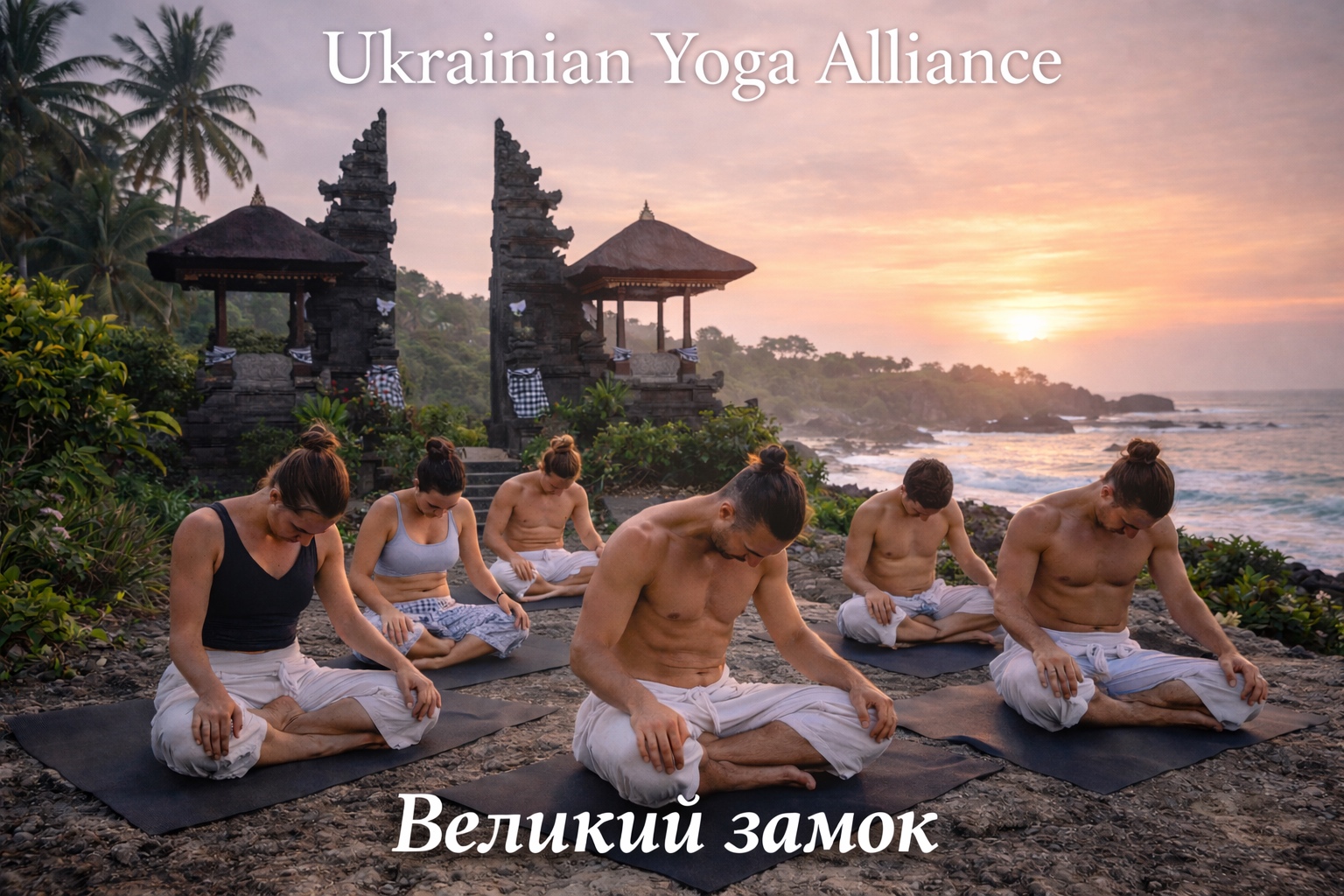
Maha Bandha — The Great Lock
You can read more about the Yoga Instructor Course on the course website:
kurspoyoge.com
Course registration:
📞 Phone: +380984777777
(Viber / Telegram / WhatsApp)
Yoga Alliance website:
yogaalliance.com.ua
Systematic Control of Prana, Consciousness, and Physiology in Classical Hatha Yoga
In classical hatha yoga, bandhas (energy locks) are a fundamental tool for regulating prana, breath, the nervous system, and consciousness.
Their role extends far beyond physical technique. Bandhas are regarded as a core mechanism of inner transformation, without which a complete practice of pranayama, kriyas, dharana, and meditation is impossible.
For future yoga teachers, deep understanding and practical mastery of bandhas are an essential component of professional training.
The Essence of Bandhas: Not Closure, but Expansion
The Sanskrit word bandha translates as “lock,” “seal,” or “binding.”
However, the true meaning of bandhas is paradoxical:
•on the physical level, specific areas of the body are intentionally contracted and “sealed”;
•on the mental and pranic levels, a process of release, expansion, and purification is initiated.
Bandhas function simultaneously on multiple levels:
•physical — through muscular contraction and internal organ massage;
•energetic — through redistribution and redirection of pranic flow;
•mental — through the release of deep psycho-emotional blocks.
Granthis — Psycho-Energetic Knots
Classical yogic texts describe the existence of granthis — psycho-energetic knots that obstruct the free flow of prana and limit the evolution of consciousness.
The primary granthis are located:
•in the region of the Muladhara Chakra,
•in the region of the Anahata Chakra,
•in the region of the Ajna Chakra.
These knots manifest as:
•chronic bodily tension;
•emotional instability;
•irritability and impulsive behavior;
•recurring life conflicts and persistent neurotic patterns.
Bandhas are traditionally regarded as one of the most effective methods for releasing granthis, as they address the root cause rather than surface symptoms.
Maha Bandha — The Great Lock
Maha Bandha is the simultaneous application of the three primary energy locks:
•Mula Bandha — the root lock
•Uddiyana Bandha — the abdominal lock
•Jalandhara Bandha — the throat lock
When combined, these bandhas cease to function as isolated techniques and become a unified system for regulating the entire pranic structure of the human being.
Two Levels of the Great Lock
Antaranga Maha Bandha — Inner Great Lock
Performed with breath retention after a full inhalation (air retained inside).
Sequence:
•locks are applied from top to bottom:
Jalandhara → Uddiyana → Mula
•released in the reverse order.
Effects:
•saturates the body with vital energy;
•activates the sushumna nadi;
•enhances inner stability and focus;
•deepens concentration and meditative states.
Bahiranga Maha Bandha — Outer Great Lock
Performed with breath retention after a full exhalation (air retained outside).
Sequence:
•locks are applied from bottom to top:
Mula → Uddiyana → Jalandhara
•released in the reverse order.
Effects:
•supports detoxification processes;
•purifies organs and energy channels;
•amplifies the effects of cleansing practices.
Integrating Maha Bandha with Pranayama
For yoga teachers, it is essential not only to understand bandhas individually but also to integrate them skillfully into breathing practices.
Core applications:
1. Maha Bandha + Nadi Shodhana
•inhalation
•Great Lock
•exhalation
2. Maha Bandha + Kapalabhati
•one cycle of Kapalabhati (approximately 10 minutes);
•Great Lock after exhalation;
•second cycle of Kapalabhati;
•Great Lock after inhalation.
Focus of attention:
on the Manipura Chakra, visualizing a bright solar light in the solar plexus radiating throughout the entire body.
Mula Bandha — The Root Lock
Mula Bandha is the contraction of the perineal region, associated with regulation of apana vayu and activation of the Muladhara Chakra.
Anatomical focus:
•in men — the area between the anus and the genitals;
•in women — the region of the cervix.
It is important to note that simple contraction of the anal sphincter is not Mula Bandha.
Stages of mastery:
1.physical contraction;
2.combined physical and mental engagement;
3.purely mental control without external tension.
Effects:
•improves blood circulation in the pelvic region;
•enhances control over the urogenital system;
•increases sexual vitality;
•directs prana toward the brain;
•dissolves deep neural and psycho-emotional patterns.
Yogic tradition states that the effects of Mula Bandha surpass those of modern psychotherapeutic methods.
Uddiyana Bandha — The Abdominal Lock
The word uddiyana means “rising” or “flying upward.”
The technique is named so because the diaphragm lifts upward, generating powerful energetic effects.
Physiological effects:
•massage of the digestive organs;
•stimulation of the adrenal glands;
•activation of the solar plexus;
•normalization of the sympathetic nervous system.
Psycho-emotional effects:
•reduction of stress levels;
•cultivation of inner well-being;
•prevention of psychosomatic disorders.
Jalandhara Bandha — The Throat Lock
Jalandhara Bandha regulates the pranic and nervous networks of the neck and throat region.
Effects:
•regulation of blood pressure;
•stabilization of heart rhythm;
•stimulation of the thyroid gland;
•calming of the mind;
•preparation for meditation.
This practice has a pronounced effect on the parasympathetic nervous system, inducing deep relaxation.
Contraindications and Teacher Responsibility
Contraindications for Maha Bandha are the combined contraindications of all three bandhas.
A yoga teacher must:
•clearly understand physiological limitations;
•be able to adapt practices for different student levels;
•prevent uncontrolled breath retention among beginners.
Methodological Principle of Training
Our task in every practice is to apply all bandhas.
Even when bandhas are not externally visible, internal awareness of the locks forms professional depth and ensures student safety.
Teacher Training and Certification
The Ukrainian Yoga Alliance is the largest non-profit organization responsible for establishing and maintaining yoga teaching standards in Ukraine.
The main areas of activity of the Alliance include:
•uniting the professional yoga community;
•developing and approving qualification requirements;
•official certification of yoga instructors;
•maintaining the Unified Register of Certified Teachers.
The Ukrainian Yoga Alliance is the largest non-profit organization that establishes and maintains yoga teaching standards in Ukraine.
The main areas of activity of the Alliance include:
•uniting the professional yoga community,
•developing and approving qualification requirements,
•official certification of yoga instructors,
•maintaining the Unified Register of Certified Yoga Teachers.
Training Format and Examination
Within online yoga instructor training courses, students of the Yoga Alliance School undergo mandatory practical and theoretical assessment.
Passing Surya Namaskar is part of the examination process.
A video of the exam, conducted within online courses, is available via the link — click to watch.
You can watch a full video overview of the online course by the Head of the Yoga Alliance, Vladimir Bondarenko, on our YouTube channel by following the link.
Training Locations and Tuition Fees
Branches of the Yoga Alliance School have resumed operations in the following cities:
• Kyiv
• Kharkiv
• Dnipro
• Odesa
• Lviv
• Klaipėda (Lithuania)
• Bansko (Bulgaria)
• Athens (Greece)
• Prague (Czech Republic)
• Torrevieja (Spain)
• Vienna (Austria)
• Cascais (Portugal)
These branches offer continuously running offline yoga instructor training courses led by senior instructors of the Alliance.
Tuition fees:
•online course — 15,500 UAH
•offline course — 17,500 UAH
Since August 2022, instructors who successfully pass examinations with distinction receive the right to train future yoga instructors on behalf of the Yoga Alliance and conduct teacher training courses jointly with the Organization.
Such instructors receive the status of Senior Instructor of the Yoga Alliance and earn 50% of the course fee for each student.
For full details, contact us via Viber / Telegram / WhatsApp:
+380984777777
Training Results
After completing the one-month course and successfully passing the exams, you will:
•receive two international Yoga Alliance certificates registered with the Ministry of Justice of Ukraine;
•obtain the right to teach yoga in more than 100 countries worldwide;
•master a well-structured class format including kriyas, pranayama, and meditation;
•receive lifetime access to video lessons, an application for learning posture names, and 12 balanced printed lesson plans for the first year of teaching;
•receive the “Gold Standard” methodological guide — a detailed manual on asanas, chakras, mudras, bandhas, and key techniques of classical yoga.
Additional Materials
Contacts and Registration
You can read more about the Yoga Instructor Course on the course website:
Course registration:
📞 Phone: +380984777777
(Viber / Telegram / WhatsApp)
Yoga Alliance website:
Оставить комментарий