
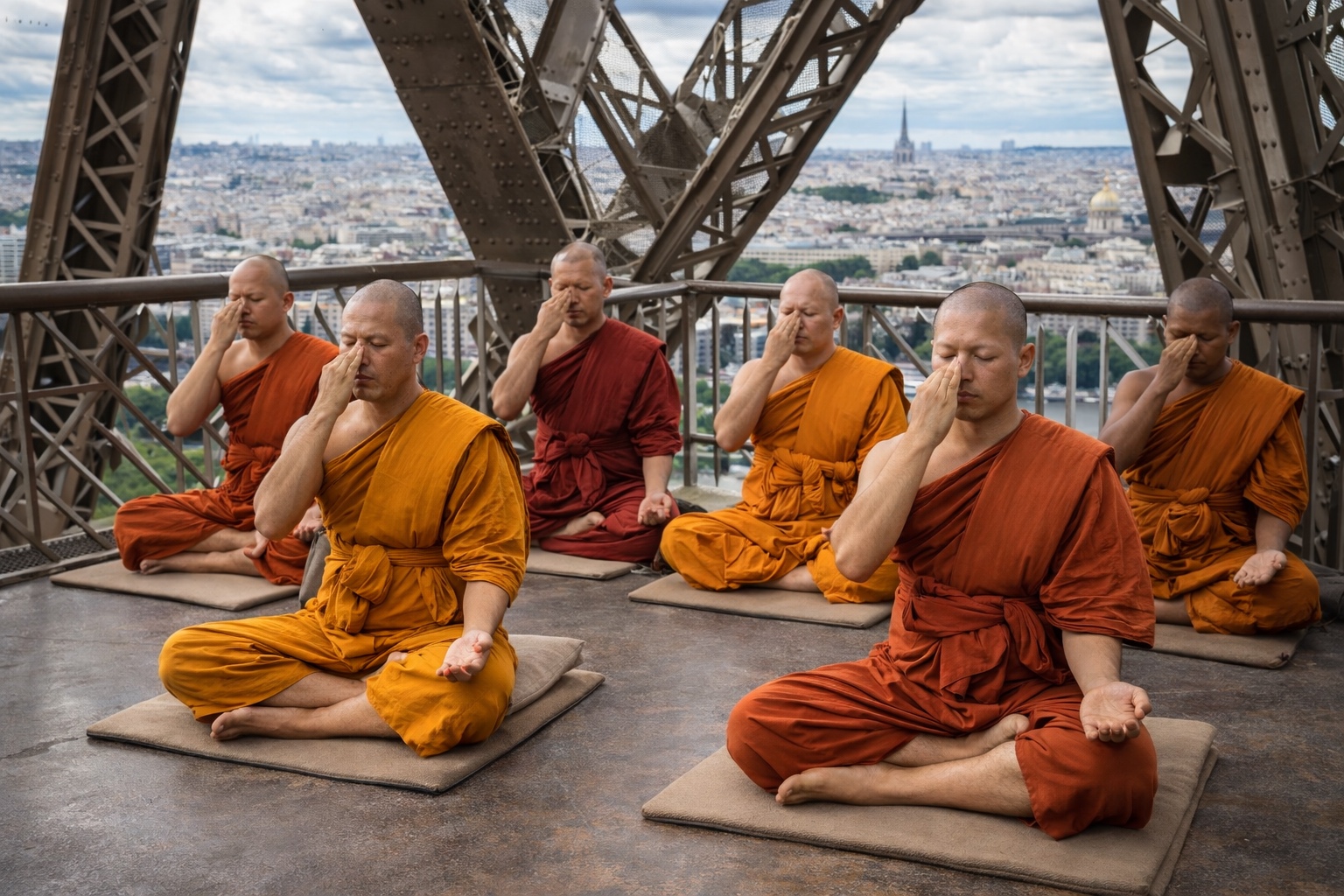
Pranayama. Breathing Techniques and Breathing Practices
You can read more about the Yoga Instructor Course on the course website:
kurspoyoge.com
Course registration:
📞 Phone: +380984777777
(Viber / Telegram / WhatsApp)
Yoga Alliance website:
yogaalliance.com.ua
Basic and Advanced Module in Yoga Teacher Training
In the ancient treatise Hatha Yoga Pradipika it is said:
“Life is the interval between two breaths.
One who breathes halfway lives only halfway.
One who breathes correctly governs the whole of their being.”
This shloka reflects the fundamental view of classical yoga on breathing: breath is not merely a physiological process, but the primary tool for managing vital energy, the state of the mind, and the quality of consciousness.
In the system of professional yoga teacher training, pranayama occupies a central place, since it is through breath that direct influence is exerted on:
•the pranic body,
•the nervous system,
•the psycho-emotional state,
•concentration and deep states of the mind.
Pranayama as the Science of Managing Prana
Pranayama is a method of conscious control of prana through breathing.
Its purpose is the purification, balancing, and expansion of the pranic body, as well as the gradual transformation of the physical and mental levels of a human being.
In the classical tradition, pranayama:
•removes blockages in the energy channels (nadis),
•balances the flow of prana,
•prepares consciousness for dharana and meditation,
•strengthens health and the stability of the nervous system.
In the Hatha Yoga Pradipika it is said:
“When pranayama is practiced correctly,
the entire body of prana becomes unified.
Through sushumna prana flows freely,
because pranayama removes all obstacles
that hinder the free flow of prana
and brings calmness to the mind.”
From the perspective of instructor training, this means that pranayama is not an optional practice, but an essential tool of professional competence.
Pranayama and Asanas: Similarities and Differences
Both asanas and pranayama serve the same purpose — the harmonization of body, energy, and consciousness. However, their modes of influence differ.
•Asanas work primarily through the physical body, affecting muscles, joints, fascia, and internal organs.
•Pranayama acts directly through the pranic body, which is more closely connected to the mind and nervous system than the physical structure.
For this reason, pranayama:
•affects the state of the mind more quickly,
•has a stronger impact on the emotional background,
•requires a more conscious and careful approach.
For the instructor, this implies increased responsibility when transmitting breathing techniques to students.
The Role of Pranayama in Yoga Teacher Training
In a professional course, a yoga instructor studies pranayama not only as a personal practice, but also as a tool for teaching and supporting other people.
An instructor must:
•understand the mechanisms of action of each technique,
•know indications and contraindications,
•be able to adapt the practice to different levels of preparation,
•monitor the condition of students during pranayama practice.
Pranayama without understanding may become mechanical breathing.
Pranayama with understanding becomes a method of transformation.
General Rules for Practicing Pranayama
Methodological Foundation for the Instructor
Posture for Practicing Pranayama
The posture should be stable, symmetrical, and free from tension.
At the initial stage of training:
•Sukhasana,
•Vajrasana.
As the body opens and the practice stabilizes:
•Ardha Padmasana,
•Padmasana,
•Siddhasana (Siddha Yoni Asana).
The instructor must be able to correctly select a posture based on the anatomical and physiological characteristics of the student.
Conditions and Place of Practice
The place for practicing pranayama should:
•be clean,
•be well ventilated,
•be free of strong odors,
•be protected from strong drafts,
•be free from insects and distracting factors.
Air quality directly affects the quality of pranayama; therefore, practice conditions are of fundamental importance.
Time of Practice and Nutrition
Pranayama should be practiced:
•at least 30 minutes before meals,
•or 4 hours after eating.
For deeper practice, moderation in diet is necessary. In the yogic tradition, there is a rule:
“Fill the stomach halfway with food,
one quarter with water,
and the remaining quarter with air.”
The instructor is obliged to convey to students an understanding of the relationship between nutrition, breathing, and the state of the mind.
Preparation of the Respiratory Pathways
If necessary, before practice it is recommended to perform jala neti — cleansing of the nasal passages with saline water.
This:
•improves airway patency,
•increases the effectiveness of pranayama,
•reduces the risk of discomfort during practice.
Awareness as a Key Element of Pranayama
Pranayama is impossible without awareness.
Automatic breathing is not pranayama.
During practice it is important to:
•be aware of the phases of inhalation, exhalation, and retention,
•observe the movement of breath in the body,
•track work with a specific energy center or channel.
If the mind becomes distracted, this is natural.
The task of the practitioner and instructor is:
•not to suppress the mind,
•not to become irritated,
•to gently return attention to the breath or the object of concentration.
Duration of Practice
The maximum effect of pranayama begins to manifest after 20 minutes of conscious breathing.
However, in instructor training it is important to:
•begin with short sessions,
•gradually increase the duration,
•take into account individual physiological responses.
The Principle of Non-Violence in Breathing
Breathing should be:
•smooth,
•controlled,
•free from tension.
Any force, haste, or coercion:
•disrupts the flow of prana,
•overloads the nervous system,
•contradicts the principles of classical yoga.
The instructor must ensure that pranayama never turns into competition or a struggle with the breath.
Conclusion for the Instructor
Pranayama is not merely a breathing technique.
It is a science of managing vital energy, requiring maturity, discipline, and responsibility.
Within the system of yoga teacher training, pranayama:
•builds professional depth,
•develops the ability to work with states of consciousness,
•makes teaching conscious and safe.
Teacher Training and Certification
The Ukrainian Yoga Alliance is the largest non-profit organization responsible for establishing and maintaining yoga teaching standards in Ukraine.
The main areas of activity of the Alliance include:
•uniting the professional yoga community;
•developing and approving qualification requirements;
•official certification of yoga instructors;
•maintaining the Unified Register of Certified Teachers.
The Ukrainian Yoga Alliance is the largest non-profit organization that establishes and maintains yoga teaching standards in Ukraine.
The main areas of activity of the Alliance include:
•uniting the professional yoga community,
•developing and approving qualification requirements,
•official certification of yoga instructors,
•maintaining the Unified Register of Certified Yoga Teachers.
Training Format and Examination
Within online yoga instructor training courses, students of the Yoga Alliance School undergo mandatory practical and theoretical assessment.
Passing Surya Namaskar is part of the examination process.
A video of the exam, conducted within online courses, is available via the link — click to watch.
You can watch a full video overview of the online course by the Head of the Yoga Alliance, Vladimir Bondarenko, on our YouTube channel by following the link.
Training Locations and Tuition Fees
Branches of the Yoga Alliance School have resumed operations in the following cities:
• Kyiv
• Kharkiv
• Dnipro
• Odesa
• Lviv
• Klaipėda (Lithuania)
• Bansko (Bulgaria)
• Athens (Greece)
• Prague (Czech Republic)
• Torrevieja (Spain)
• Vienna (Austria)
• Cascais (Portugal)
These branches offer continuously running offline yoga instructor training courses led by senior instructors of the Alliance.
Tuition fees:
•online course — 15,500 UAH
•offline course — 17,500 UAH
Since August 2022, instructors who successfully pass examinations with distinction receive the right to train future yoga instructors on behalf of the Yoga Alliance and conduct teacher training courses jointly with the Organization.
Such instructors receive the status of Senior Instructor of the Yoga Alliance and earn 50% of the course fee for each student.
For full details, contact us via Viber / Telegram / WhatsApp:
+380984777777
Training Results
After completing the one-month course and successfully passing the exams, you will:
•receive two international Yoga Alliance certificates registered with the Ministry of Justice of Ukraine;
•obtain the right to teach yoga in more than 100 countries worldwide;
•master a well-structured class format including kriyas, pranayama, and meditation;
•receive lifetime access to video lessons, an application for learning posture names, and 12 balanced printed lesson plans for the first year of teaching;
•receive the “Gold Standard” methodological guide — a detailed manual on asanas, chakras, mudras, bandhas, and key techniques of classical yoga.
Additional Materials
Contacts and Registration
You can read more about the Yoga Instructor Course on the course website:
Course registration:
📞 Phone: +380984777777
(Viber / Telegram / WhatsApp)
Yoga Alliance website:
Оставить комментарий