
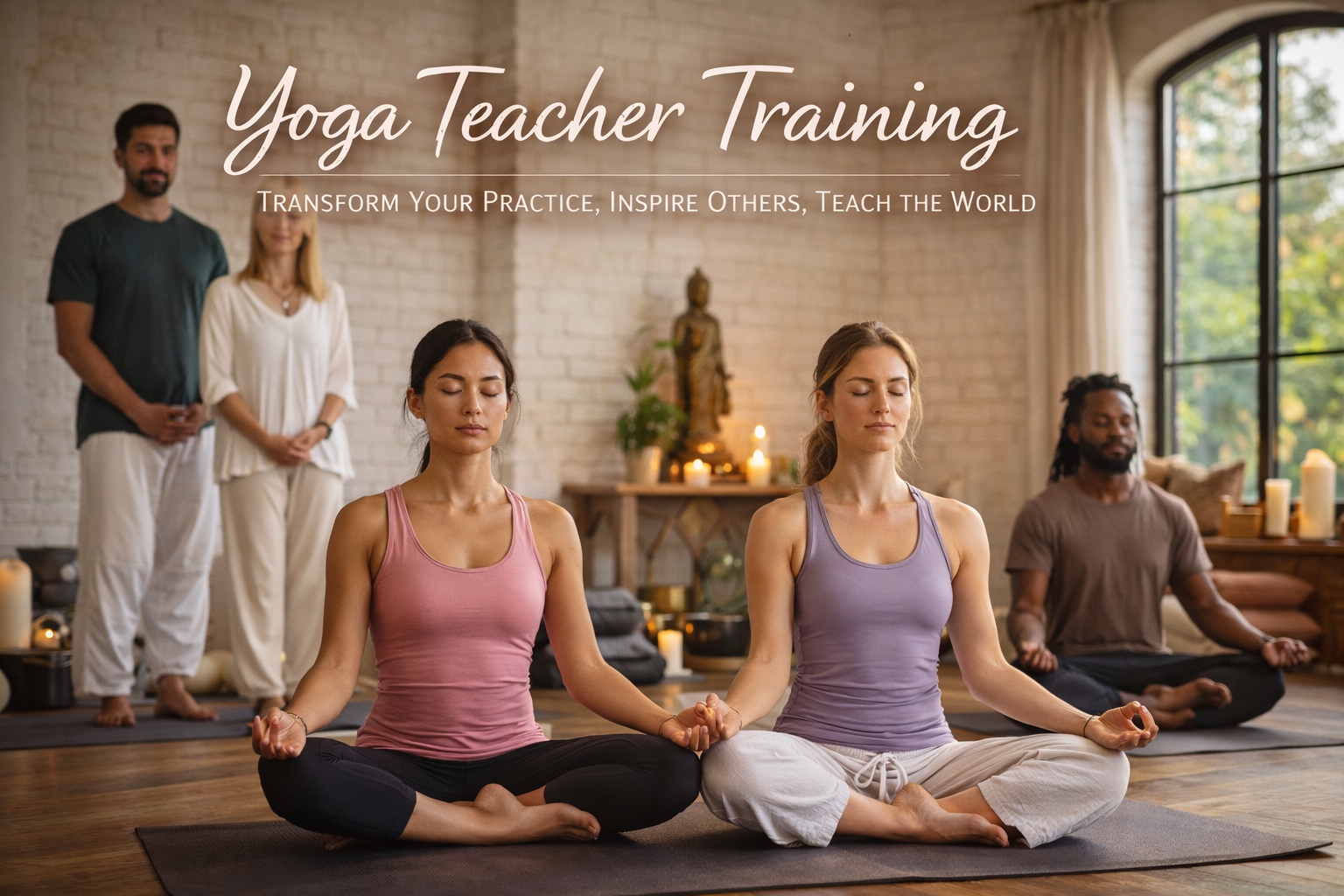
Rules of Yoga Practice
You can read more about the Yoga Instructor Course on the course website:
kurspoyoge.com
Course registration:
📞 Phone: +380984777777
(Viber / Telegram / WhatsApp)
Yoga Alliance website:
yogaalliance.com.ua
How to Practice Yoga Correctly and Why It Must Be Learned Professionally
Yoga is not a set of exercises and not a fitness format for maintaining physical shape. In the classical tradition, yoga is a holistic system of working with the body, breath, nervous system, and consciousness. That is why the quality of practice is determined not by the complexity of asanas, but by the correctness of the approach.
Most mistakes in yoga arise not from a lack of flexibility or strength, but from ignorance of the fundamental principles of practice. These principles are necessarily studied in professional yoga teacher training courses—and it is they that form a safe, deep, and transformative practice.
Below are the key rules of yoga practice, without understanding which neither personal development in practice nor professional teaching is possible.
1. Cold Ablutions and the State of Alertness
During yoga practice it is very easy to fall into a state of drowsiness. This is especially typical of morning practice or for people with an exhausted nervous system. Drowsiness may be accompanied by pleasant sensations or even dreams; however, from the yogic perspective this is a dead-end state that does not lead to the development of awareness.
One of the classical methods of preparing the body and mind for practice is cold ablutions. A cold shower before practice activates the nervous system, improves the circulation of prana, and helps maintain clarity of consciousness. If a cold shower is not possible, it is recommended at least to wash the face with cold water.
In yoga teacher training courses, the influence of temperature, water, and external factors on the state of the mind and the effectiveness of practice is studied in detail.
2. Place of Practice and the Formation of a Practice Space
It is recommended to practice yoga in the same place every day. Over time, a stable positive energetic atmosphere is formed in this space, which begins to support the practice by itself.
The place should be:
•clean and calm
•well ventilated, but without drafts
•dry
•not too cold and not too hot
Practicing on a bare floor is категорically not recommended. Mats, blankets, or special underlays should be used.
In professional yoga teacher training courses, attention is paid not only to asanas, but also to creating the practice space, which is especially important for future teachers.
3. Clothing for Practice
Clothing for yoga practice should be light, loose, and not restrictive to breathing. Tight or rigid clothing interferes with the natural movement of the rib cage and diaphragm and limits freedom of movement.
A yoga teacher must understand how clothing affects breathing, thermoregulation, and the student’s concentration—this is also taught in professional programs.
4. Nasal Cleansing and Preparation of the Respiratory Pathways
Practicing yoga with a blocked nose is extremely difficult. Free breathing is the foundation of asanas, pranayama, and meditation.
If necessary, it is recommended to cleanse the nasal passages before practice using Jala Neti (nasal rinsing with saline water). This improves airway patency, balances the nervous system, and enhances concentration.
In yoga teacher training courses, shatkarmas and cleansing techniques are given a separate block, since deep mastery of pranayama is impossible without them.
5. Awareness as the Basis of Yogic Practice
At the beginning of the path, attention almost always wanders. Thoughts are distracted; images, emotions, and memories arise. This is normal and not a mistake.
It is important:
•not to suppress thoughts
•not to fight them
•to observe them and gently return attention to the practice
Awareness should be maintained:
•in the body
•in the breath
•in the position of the spine
•in the energy centers (chakras)
Concentration of the mind on one object is the essence of all forms of yoga: asana, pranayama, mudra, and meditation.
The parable about the guru and attention clearly shows that awareness is the key to everything. It is the development of awareness that transforms practice from physical gymnastics into yoga.
6. Regularity and Discipline
Yoga requires regularity. Practice should be performed daily, except during periods of illness.
It is important to make an inner decision to practice every day—not as an obligation, but as a path. This decision must penetrate the deeper layers of the subconscious mind.
In yoga teacher training courses, great attention is paid to the formation of personal discipline, without which neither personal development nor teaching is possible.
7. Nutrition and Intervals Before and After Practice
It is recommended to begin yoga practice:
•3–4 hours after eating
•not in a state of severe hunger
After consuming alcohol, practice is possible only after 48 hours.
After practice, it is recommended to eat no earlier than 40–60 minutes, in order to preserve the subtle state of the nervous system.
These aspects are studied in detail in professional courses, since a teacher bears responsibility for the health of students.
8. Practice During Illness
Yoga practice is excluded during illness and elevated body temperature. Yoga is not a struggle with the body, but cooperation with it.
9. Safety and Comfort in Asanas
Sharp painful sensations during practice are unacceptable. Asanas are performed with minimal tension.
It is important to:
•relax muscles not involved in the posture
•keep the face, head, and eyes relaxed
•work within comfortable limits of stretching
These principles form the basis of competent teaching and are necessarily studied in yoga teacher training courses.
10. Duration of Holding Asanas
The general rule:
•difficult postures — from 30 seconds
•physically easy postures — from 1 minute or more
However, more important than time is the quality of presence and breathing.
11. The Principle of Compensation
Each asana has both positive and potentially negative effects. To enhance the positive and neutralize possible imbalances, compensatory postures are used.
Basic principles:
•the compensatory posture is simpler than the main one
•holding time is about 30% of the time of the main posture
•asymmetrical asanas are performed equally on both sides
•strength postures alternate with relaxing ones
Formula: posture — counter-posture — relaxation.
12. Working with Chakras
Asanas are performed with the activation of energy centers from bottom to top. It is recommended to complete the practice with a headstand or a similar technique that activates the Sahasrara Chakra.
Understanding energetic anatomy is an essential part of professional yoga teacher training.
13. Principles of Breathing
Breathing is the foundation of yoga.
The classical principle:
•before the posture — inhalation
•entering the posture — breath retention
•after entering — exhalation
In asana, breathing is calm and extended. In difficult postures, Ujjayi breathing is used.
Why It Is Important to Take a Yoga Teacher Training Course
All of the above principles cannot be fully mastered independently. That is why professional yoga teacher training courses are not merely preparation for teaching, but a deep transformation of personal practice.
In the course you:
•study classical Hatha Yoga
•master pranayama and shatkarmas
•understand the work of chakras and energy channels
•learn to conduct practice safely and competently
•receive international certification
Yoga begins with correct understanding.
And the path to this understanding is professional education.
Teacher Training and Certification
The Ukrainian Yoga Alliance is the largest non-profit organization responsible for establishing and maintaining yoga teaching standards in Ukraine.
The main areas of activity of the Alliance include:
•uniting the professional yoga community;
•developing and approving qualification requirements;
•official certification of yoga instructors;
•maintaining the Unified Register of Certified Teachers.
The Ukrainian Yoga Alliance is the largest non-profit organization that establishes and maintains yoga teaching standards in Ukraine.
The main areas of activity of the Alliance include:
•uniting the professional yoga community,
•developing and approving qualification requirements,
•official certification of yoga instructors,
•maintaining the Unified Register of Certified Yoga Teachers.
Training Format and Examination
Within online yoga instructor training courses, students of the Yoga Alliance School undergo mandatory practical and theoretical assessment.
Passing Surya Namaskar is part of the examination process.
A video of the exam, conducted within online courses, is available via the link — click to watch.
You can watch a full video overview of the online course by the Head of the Yoga Alliance, Vladimir Bondarenko, on our YouTube channel by following the link.
Training Locations and Tuition Fees
Branches of the Yoga Alliance School have resumed operations in the following cities:
• Kyiv
• Kharkiv
• Dnipro
• Odesa
• Lviv
• Klaipėda (Lithuania)
• Bansko (Bulgaria)
• Athens (Greece)
• Prague (Czech Republic)
• Torrevieja (Spain)
• Vienna (Austria)
• Cascais (Portugal)
These branches offer continuously running offline yoga instructor training courses led by senior instructors of the Alliance.
Tuition fees:
•online course — 15,500 UAH
•offline course — 17,500 UAH
Since August 2022, instructors who successfully pass examinations with distinction receive the right to train future yoga instructors on behalf of the Yoga Alliance and conduct teacher training courses jointly with the Organization.
Such instructors receive the status of Senior Instructor of the Yoga Alliance and earn 50% of the course fee for each student.
For full details, contact us via Viber / Telegram / WhatsApp:
+380984777777
Training Results
After completing the one-month course and successfully passing the exams, you will:
•receive two international Yoga Alliance certificates registered with the Ministry of Justice of Ukraine;
•obtain the right to teach yoga in more than 100 countries worldwide;
•master a well-structured class format including kriyas, pranayama, and meditation;
•receive lifetime access to video lessons, an application for learning posture names, and 12 balanced printed lesson plans for the first year of teaching;
•receive the “Gold Standard” methodological guide — a detailed manual on asanas, chakras, mudras, bandhas, and key techniques of classical yoga.
Additional Materials
Contacts and Registration
You can read more about the Yoga Instructor Course on the course website:
Course registration:
📞 Phone: +380984777777
(Viber / Telegram / WhatsApp)
Yoga Alliance website:
Оставить комментарий