
Daily Practices for Cleansing the Body: Basti Kriya and the Root Lock
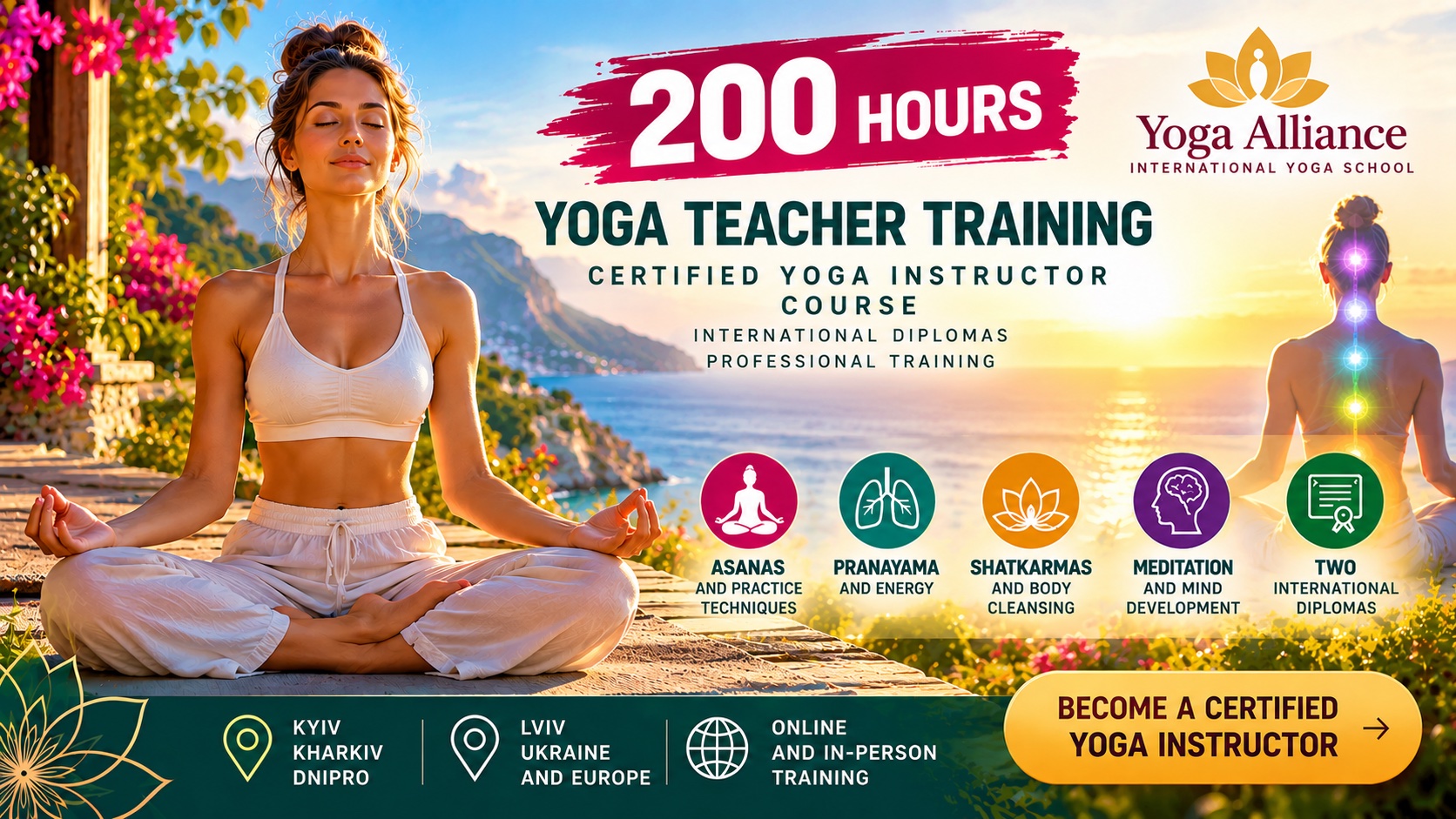
Yoga Teacher Training — International Yoga Instructor Course by Yoga Alliance Ukraine
You can read more about the Yoga Instructor Course on the course website:
kurspoyoge.com
Course registration:
📞 Phone: +380984777777
(Viber / Telegram / WhatsApp)
Yoga Alliance website:
yogaalliance.com.ua
In the tradition of yoga, special attention is given not only to the practice of asanas, the development of flexibility, strength and endurance, or the practice of pranayama. Cleansing practices — known as Shatkarmas — are also an important part of the yogic system.
According to the traditional approach to yoga, preparing the body is considered an important stage in the further development of one’s practice. Regular work with the body, breath and attention is believed to help practitioners become more aware of their physical and mental state, develop greater control over their breathing, and gradually progress toward deeper practices of concentration and meditation.
For this reason, purification practices occupy an important place in the classical system of Hatha Yoga.
In yoga, the concept of purification is much broader than ordinary physical hygiene. It involves working simultaneously with the body, breath, attention and inner state.
As the body becomes better prepared, practitioners may find it easier to perform asanas, work with the breath and maintain concentration. Gradually, yoga develops from a collection of physical exercises into a comprehensive system of working with the body and consciousness.
The Six Yogic Cleansing Practices
Traditionally, six principal groups of cleansing techniques are described. They are known collectively as the Shatkarmas — from the Sanskrit words shat, meaning “six,” and karma, meaning “action.”
A practical system of yogic training may include the following techniques:
1. Jala Neti — cleansing the nasal passages with saline water.
This practice is traditionally used for nasal hygiene and to prepare the respiratory passages before certain breathing practices.
2. Basti Kriya and Mula Bandha practice — work involving the pelvic floor muscles and the lower energetic center.
This practice develops conscious awareness and control of the pelvic floor and forms an important component of several more advanced yogic techniques.
3. Agnisara Kriya — active movement of the abdominal wall.
It is traditionally practiced in Hatha Yoga as a preparatory technique for certain pranayama practices and Nauli.
4. Sanchalana Nauli — wave-like control and movement of the abdominal muscles.
This is a more advanced practice requiring preparation and good voluntary control of the abdominal muscles.
5. Trataka — the practice of maintaining a steady gaze on a selected object, traditionally the flame of a candle.
It is primarily used as a concentration practice and is traditionally included among the Shatkarmas.
6. Kapalabhati — a breathing technique involving a series of active exhalations and passive inhalations.
Within the Hatha Yoga tradition, Kapalabhati is regarded as a cleansing practice and is also widely used as preparation for pranayama.
Each of these techniques has its own method of practice, limitations and contraindications. More advanced cleansing techniques should therefore be learned gradually and preferably under the supervision of a qualified yoga teacher.
Today We Will Explore Basti Kriya and Mula Bandha
A special place within yogic practice is given to working with the region traditionally associated with the Muladhara Chakra and the muscles of the pelvic floor.
The Sanskrit word mula means “root,” while bandha can be translated as “lock,” “binding,” or “holding.”
Mula Bandha is therefore commonly known as the Root Lock.
On the physical level, the practice involves the conscious contraction of specific muscles of the pelvic floor. However, within the traditional yogic system, its significance extends far beyond the purely physical action.
Muladhara — The Root of the Energetic System
Muladhara is traditionally regarded as the first chakra and the foundation of the human energetic system.
According to yogic philosophy, it is associated with basic instincts, stability, security and fundamental human drives.
For this reason, working with this area is considered more than a physical exercise.
The practitioner attempts to combine muscular action, breathing, concentration and an internal awareness of energetic movement.
During Mula Bandha practice, attention is directed toward the region associated with Muladhara Chakra.
The objective is not to contract the muscles with maximum force. Instead, the practitioner gradually develops the ability to identify the appropriate muscles and consciously control them.
With experience, a strong and relatively coarse muscular contraction can gradually become subtler, more precise and more controlled.
What Happens During Mula Bandha?
On the physical level, Mula Bandha involves contraction of the pelvic floor muscles.
This region contains muscles, connective tissues and neural structures involved in supporting the pelvic organs and participating in several physiological functions.
Regular conscious work with the pelvic floor can help a person develop greater awareness and voluntary control of these muscles.
Within the traditional yogic model, Mula Bandha is also associated with another important function — influencing the direction of Apana Vayu.
Apana is traditionally described as one of the five principal movements or expressions of prana and is associated with the lower part of the body.
According to the yogic energetic model, through Mula Bandha the practitioner attempts to redirect the habitual downward movement of Apana and guide this energy upward.
The movement of prana is then traditionally associated with Sushumna — the central energetic channel, which is described as passing through the system of chakras toward Ajna and Sahasrara.
It is important to understand that concepts such as prana, chakras, Sushumna and Apana Vayu belong to the traditional philosophical and energetic framework of yoga and are not anatomical structures recognized by modern medicine.
Mula Bandha and the State of Mind
Yoga views the body and mind as interconnected aspects of a single system.
Body position, breathing, muscular tension and focused attention can influence a person’s subjective mental and emotional state.
For this reason, Bandhas are not traditionally regarded as merely mechanical muscular contractions.
During the practice, attention should remain focused while the practitioner observes internal sensations.
With proper training, one gradually develops the ability to maintain a gentle and controlled contraction without unnecessarily tensing other areas of the body.
The face, shoulders and abdomen should remain as relaxed as possible, while breathing remains calm whenever the particular technique allows it.
For many practitioners, this focused awareness also becomes a form of meditative practice.
How to Practice the Root Lock
Traditional approaches to learning Mula Bandha may use specific meditation postures.
One classical option is Siddhasana for men and Siddha Yoni Asana for women.
In traditional descriptions, the heel of one foot is positioned to create gentle pressure in the region of the perineum.
For men, the traditional reference point is the area between the scrotum and the anus.
For women, the position is adapted to female anatomy and should be performed without painful or excessive pressure.
The second leg is positioned so that the posture remains stable and allows the spine to stay upright for an extended period.
However, pressure from the heel is not essential for learning a modern form of Mula Bandha.
The primary objective is to develop conscious awareness and gentle control of the pelvic floor muscles.
Step-by-Step Practice
Sit in a comfortable and stable position.
Lengthen the spine without creating excessive muscular tension.
Relax the shoulders and face.
Take several calm inhalations and exhalations.
Bring your attention to the pelvic floor.
Gently contract the muscles in this area.
Try to avoid unnecessary contraction of the buttocks, thighs and abdomen.
Hold the contraction briefly while maintaining comfortable breathing, unless the particular technique being practiced specifically involves breath retention.
Then completely release the muscles.
Observe the sensations for several seconds.
Repeat the exercise.
As experience develops, the practitioner gradually learns to isolate the contraction more precisely while reducing unnecessary tension in surrounding muscles.
Concentration During the Practice
Mula Bandha is more than a physical technique.
During its practice, attention is traditionally concentrated in the area of Muladhara Chakra.
Within the traditional yogic model, practitioners may visualize energy moving upward along the central axis of the body.
It is important, however, not to chase unusual sensations or dramatic experiences.
Yoga requires gradual development.
First, a practitioner learns to feel the muscles.
Then, they learn to control them.
Afterward, the physical technique can gradually be integrated with breathing and concentration.
Only after sufficient preparation are Bandhas generally incorporated into more advanced practices of pranayama and meditation.
Potential Significance of the Practice
From the perspective of physical training, exercises involving conscious activation of the pelvic floor may help develop awareness and voluntary control of this group of muscles.
Traditional yogic sources also attribute broader effects to Mula Bandha involving the digestive, reproductive and energetic systems.
However, claims that Mula Bandha can treat specific diseases or guarantee improvements in sexual function should not be regarded as established medical effects.
Yoga practices may complement a healthy lifestyle, but they are not a substitute for medical diagnosis or treatment.
This is particularly important for people who already have cardiovascular, digestive, urogenital or other medical conditions.
Contraindications and Safety Precautions
More intensive forms of Bandha practice, particularly when combined with breath retention or other advanced techniques, require additional caution.
Consultation with a healthcare professional and an experienced yoga teacher is advisable in cases involving:
— uncontrolled high blood pressure;
— cardiovascular conditions;
— pregnancy or risk of pregnancy complications;
— recent abdominal or pelvic surgery;
— acute inflammatory conditions;
— significant dizziness or poor general well-being.
During menstruation, intensive Bandhas and related practices should be approached individually, taking into consideration personal comfort and appropriate professional guidance.
If pain, pronounced dizziness, weakness or any unusual symptoms occur, the practice should be stopped.
From Simple Techniques to Advanced Practice
One of the most common mistakes among beginners is attempting to move into advanced techniques too quickly.
Yoga develops differently.
First, we learn to become aware of the body.
Then we learn to work with the breath.
After that comes the ability to maintain concentration.
Only then do individual elements gradually begin to combine into a deeper and more integrated practice.
Bandhas, pranayama, Shatkarmas and meditation require not brute force, but regularity, awareness and the correct progression of training.
For this reason, techniques of this kind are best studied not through isolated short videos or random descriptions found online, but as part of a comprehensive and structured system of yoga education.
Would You Like to Study Yoga Professionally?
The Ukrainian Yoga Alliance invites you to complete a professional Yoga Teacher Training Course.
The training is designed both for people who want to explore yoga more deeply for their own personal development and for future teachers who wish to make yoga their profession.
The curriculum goes far beyond the study of asanas.
Students can progressively explore different aspects of traditional and contemporary yoga practice, including work with the body, breathing, concentration, pranayama, Bandhas, cleansing practices and other important areas of professional yoga teacher education.
Special attention is given to understanding correct technique and developing the ability to explain practices clearly and responsibly to future students.
Our objective is not simply to train someone who has memorized a sequence of asanas.
Our objective is to prepare a yoga teacher who understands yoga as a comprehensive system and is capable of working professionally with students.
After successfully completing the program and fulfilling the established requirements, graduates receive two yoga diplomas provided within the training program.
However, receiving a diploma is only the beginning of a professional journey.
We Help Our Graduates Become Recognizable Yoga Teachers
Today, being able to conduct a good yoga class is not always enough to develop a successful professional practice.
Potential students need to be able to find information about a teacher online, learn about their qualifications and decide whether they would like to study with that particular professional.
For this reason, certified instructors may be presented on 50 online resources owned by or associated with the Yoga Alliance system, in accordance with the conditions of the program.
This can help graduates establish a stronger professional presence online, increase their visibility and create additional opportunities to attract students to their classes.
For some graduates, opportunities for further cooperation with the Yoga Alliance School may also be available, depending on current vacancies and applicable selection requirements.
Yoga may begin as a personal practice and gradually become a profession and a life’s work.
Study it deeply.
Practice consciously.
And if you would like not only to practice yoga yourself but also to share this knowledge with others, take the next step and receive professional yoga teacher training.
Ukrainian Yoga Alliance: 200-Hour Yoga Instructor Training Course
The goal of the Ukrainian Yoga Alliance teacher training course is not simply to hand a student a certificate.
The goal is to prepare a person for real teaching.
For this reason, the training is built around three fundamental components:
knowledge — practice — teaching.
First, students acquire knowledge.
Then they learn to apply that knowledge in their own practice.
After that, they learn how to transfer this knowledge to other people.
Because a real yoga instructor is not the person who knows the greatest number of asana names.
A real instructor is someone who can take a complex system of knowledge and make it understandable, structured, safe, and useful for their students.
If you want to study yoga more deeply, a teacher training course can completely transform your understanding of the practice.
If you want to become an instructor, the course should provide you with a professional foundation.
If you already teach yoga, systematic education can help you organize and deepen the knowledge you have accumulated.
And if you want to make yoga part of your professional life, it is important to begin with high-quality education.
Because ultimately, students do not come to a certificate.
They come to a teacher.
To a person they trust with their body, their time, and their practice.
That is why professional yoga instructor training is not a formality.
It is responsibility.
It is knowledge.
It is practice.
It is the ability to teach.
And it is the foundation on which a future professional career is built.
The Ukrainian Yoga Alliance is not simply about receiving a yoga instructor certificate. It is a system of professional teacher preparation: 200 hours of training, the study of techniques and comprehensive educational materials, practical experience conducting classes independently, certification, and continued professional development.
If your goal is not simply to complete a course but to genuinely learn how to teach yoga, choose an education that prepares you to meet your first students with confidence, professionalism, knowledge, and responsibility.
Teacher Training and Certification
The Ukrainian Yoga Alliance is the largest non-profit organization responsible for establishing and maintaining yoga teaching standards in Ukraine.
The main areas of activity of the Alliance include:
•uniting the professional yoga community;
•developing and approving qualification requirements;
•official certification of yoga instructors;
•maintaining the Unified Register of Certified Teachers.
The Ukrainian Yoga Alliance is the largest non-profit organization that establishes and maintains yoga teaching standards in Ukraine.
The main areas of activity of the Alliance include:
•uniting the professional yoga community,
•developing and approving qualification requirements,
•official certification of yoga instructors,
•maintaining the Unified Register of Certified Yoga Teachers.
Training Format and Examination
Within online yoga instructor training courses, students of the Yoga Alliance School undergo mandatory practical and theoretical assessment.
Passing Surya Namaskar is part of the examination process.
A video of the exam, conducted within online courses, is available via the link — click to watch.
You can watch a full video overview of the online course by the Head of the Yoga Alliance, Vladimir Bondarenko, on our YouTube channel by following the link.
Training Locations and Tuition Fees
Branches of the Yoga Alliance School have resumed operations in the following cities:
• Kyiv
• Kharkiv
• Dnipro
• Odesa
• Lviv
• Klaipėda (Lithuania)
• Bansko (Bulgaria)
• Athens (Greece)
• Prague (Czech Republic)
• Torrevieja (Spain)
• Vienna (Austria)
• Cascais (Portugal)
These branches offer continuously running offline yoga instructor training courses led by senior instructors of the Alliance.
Tuition fees:
•online course — 15,500 UAH
•offline course — 17,500 UAH
Since August 2022, instructors who successfully pass examinations with distinction receive the right to train future yoga instructors on behalf of the Yoga Alliance and conduct teacher training courses jointly with the Organization.
Such instructors receive the status of Senior Instructor of the Yoga Alliance and earn 50% of the course fee for each student.
For full details, contact us via Viber / Telegram / WhatsApp:
+380984777777
Training Results
After completing the one-month course and successfully passing the exams, you will:
•receive two international Yoga Alliance certificates registered with the Ministry of Justice of Ukraine;
•obtain the right to teach yoga in more than 100 countries worldwide;
•master a well-structured class format including kriyas, pranayama, and meditation;
•receive lifetime access to video lessons, an application for learning posture names, and 12 balanced printed lesson plans for the first year of teaching;
•receive the “Gold Standard” methodological guide — a detailed manual on asanas, chakras, mudras, bandhas, and key techniques of classical yoga.
Additional Materials
Contacts and Registration
You can read more about the Yoga Instructor Course on the course website:
Course registration:
📞 Phone: +380984777777
(Viber / Telegram / WhatsApp)
Yoga Alliance website:
Курс інструктора йоги 200 годин в Україні та Європі: навчання викладачів йоги, шаткарми, Басті-крія та Мула-бандха
Навчання на викладача йоги з міжнародним дипломом: курси йоги в Києві, Харкові, Дніпрі, Львові та онлайн
Як стати інструктором йоги в Україні та Європі: професійний курс викладачів йоги та практика Басті-крія
Курси викладачів йоги онлайн та офлайн: навчання інструкторів йоги, Мула-бандха, шаткарми та професійна підготовка
Yoga Teacher Training 200 годин: міжнародне навчання викладачів йоги в Україні та країнах Європи
Щоденні практики для очищення тіла. Басті-крія та практика кореневого замка
Докладніше про Курс інструктора йоги можна прочитати на сайті Курсу: kurspoyoge.com
Запис на Курс: 📞 Телефон: +380984777777
(Viber / Telegram / WhatsApp)
Сайт Йога Альянсу: yogaalliance.com.ua
У традиції йоги особлива увага приділяється не лише виконанню асан, розвитку гнучкості, сили та витривалості або практиці пранаями. Важливою частиною йогічної системи є також очисні практики — шаткарми.
Згідно з традиційним підходом йоги, підготовка тіла розглядається як важливий етап подальшого розвитку практики. Вважається, що регулярна робота з тілом, диханням та увагою допомагає практикуючому краще відчувати власний стан, контролювати дихання та поступово переходити до глибших технік концентрації й медитації.
Саме тому в класичній системі хатха-йоги очищенню організму приділяється особливе місце.
Чистота в йозі розглядається значно ширше за звичайну гігієну. Це робота одночасно з тілом, диханням, увагою та внутрішнім станом людини.
Коли тіло стає більш підготовленим, практикуючому легше виконувати асани, працювати з диханням та утримувати концентрацію. Поступово практика стає не просто комплексом фізичних вправ, а повноцінною системою роботи з тілом і свідомістю.
Шість очисних практик йоги
Традиційно виділяють шість основних груп очисних технік — шаткарм («шат» — шість, «карма» — дія).
У практичній системі підготовки можуть використовуватися такі методи:
1. Джала-неті — очищення носових ходів за допомогою солоної води.
Практика традиційно застосовується для гігієни носової порожнини та підготовки дихальних шляхів перед виконанням дихальних технік.
2. Басті-крія та робота з Мула-бандхою — робота з м’язами тазового дна та нижнім енергетичним центром.
Практика вчить усвідомлено відчувати та контролювати м’язи ділянки промежини і є важливим елементом низки складніших йогічних технік.
3. Агнісара-крія — активна робота передньої черевної стінки.
Вона традиційно використовується в хатха-йозі як підготовча техніка перед деякими практиками пранаями та Наулі.
4. Санчалан-наулі — хвилеподібна робота м’язами живота.
Це складніша техніка, що потребує попередньої підготовки та доброго контролю м’язів передньої черевної стінки.
5. Тратака — практика нерухомої концентрації погляду на обраному об’єкті, часто на полум’ї свічки.
Вона використовується передусім як практика концентрації уваги та традиційно належить до шаткарм.
6. Капалабхаті — дихальна техніка із серією активних видихів і пасивних вдихів.
У традиції хатха-йоги Капалабхаті належить до очисних практик і водночас широко використовується під час підготовки до пранаями.
Кожна з цих технік має свої правила виконання, обмеження та протипоказання. Тому складні очисні практики бажано опановувати поступово та під керівництвом кваліфікованого викладача.
Сьогодні поговоримо про Басті-крію та Мула-бандху
Особливе місце в практиці займає робота з ділянкою Муладхара-чакри та м’язами тазового дна.
Слово «мула» перекладається із санскриту як «корінь», а «бандха» — як «замок», «зв’язування» або «утримання».
Таким чином, Мула-бандха — це «кореневий замок».
На фізичному рівні практика пов’язана з усвідомленим скороченням певних м’язів тазового дна. Проте в традиції йоги її значення розглядається значно ширше.
Муладхара — корінь енергетичної системи
Муладхара традиційно вважається першою чакрою та основою всієї енергетичної системи людини.
Згідно з йогічною філософією, саме з нею пов’язують базові інстинкти людини, відчуття безпеки, стійкості та фундаментальні життєві прагнення.
Тому робота з цією ділянкою використовується не лише як фізична вправа.
Практикуючий намагається поєднати м’язову дію, дихання, концентрацію уваги та внутрішнє відчуття руху енергії.
Під час виконання Мула-бандхи увага спрямовується в ділянку Муладхара-чакри.
Головне завдання полягає не в максимально сильному напруженні м’язів, а в розвитку здатності точно відчувати потрібну ділянку та свідомо нею керувати.
З часом грубе фізичне напруження має ставати тоншим і більш контрольованим.
Що відбувається під час виконання Мула-бандхи?
На фізичному рівні відбувається скорочення м’язів тазового дна.
Ця ділянка містить м’язи, зв’язки та нервові структури, що беруть участь у підтримці органів малого таза та контролі низки фізіологічних функцій.
Регулярна усвідомлена робота з м’язами тазового дна допомагає людині краще відчувати цю ділянку та розвивати м’язовий контроль.
У традиційній йогічній системі Мула-бандсі також приписується ще одна важлива функція — керування напрямком апана-ваю.
Апана розглядається як один із п’яти основних потоків прани та традиційно пов’язується з нижньою частиною тіла.
Згідно з йогічною моделлю, за допомогою Мула-бандхи практикуючий прагне змінити звичний напрямок руху апани та спрямувати енергію вгору.
Далі рух прани символічно пов’язується із Сушумною — центральним енергетичним каналом, що проходить через систему чакр до Аджни та Сахасрари.
Важливо розуміти, що поняття прани, чакр, Сушумни та апана-ваю належать до традиційної філософської та енергетичної моделі йоги й не є анатомічними структурами в сучасному медичному розумінні.
Мула-бандха та стан розуму
Йога розглядає тіло й розум як взаємопов’язані частини єдиної системи.
Положення тіла, дихання, м’язове напруження та концентрація уваги здатні впливати на суб’єктивний емоційний стан людини.
Саме тому бандхи ніколи не розглядаються виключно як механічне скорочення м’язів.
Під час практики необхідно зберігати увагу та спостерігати за власними відчуттями.
За правильного виконання поступово з’являється здатність утримувати невелике контрольоване напруження без надмірних зусиль інших частин тіла.
Обличчя, плечі, живіт і дихання, наскільки це можливо, мають залишатися спокійними.
Для багатьох практикуючих така концентрація стає додатковою формою медитативної роботи.
Техніка виконання кореневого замка
У традиційних варіантах навчання Мула-бандхи можуть використовуватися спеціальні медитативні положення тіла.
Одним із класичних варіантів є Сіддхасана для чоловіків та Сіддха-йоні-асана для жінок.
У традиційному описі техніки п’ята однієї ноги розташовується таким чином, щоб створювати м’який тиск у ділянці промежини.
У чоловіків орієнтиром традиційно вважається ділянка між мошонкою та анусом.
У жінок положення адаптується з урахуванням анатомії жіночого тіла та виконується без болісного тиску.
Друга нога розташовується таким чином, щоб поза залишалася стійкою та дозволяла тривалий час зберігати пряме положення хребта.
Однак тиск п’ятою не є обов’язковою умовою для опанування сучасного варіанта Мула-бандхи.
Головне — навчитися свідомо відчувати та м’яко скорочувати м’язи тазового дна.
Послідовність практики
Прийміть зручне стійке положення.
Випряміть хребет, але не створюйте надмірного напруження.
Розслабте плечі та обличчя.
Зробіть кілька спокійних вдихів і видихів.
Переведіть увагу в ділянку тазового дна.
Потім м’яко скоротіть м’язи цієї ділянки.
Намагайтеся уникати надмірного напруження сідниць, стегон і живота.
Утримуйте скорочення нетривалий час, зберігаючи спокійне дихання, якщо конкретна техніка не передбачає його затримки.
Після цього повністю розслабте м’язи.
Кілька секунд спостерігайте за відчуттями.
Потім повторіть вправу.
У міру накопичення досвіду практикуючий навчається дедалі точніше локалізувати скорочення та зменшувати непотрібне напруження сусідніх м’язів.
Концентрація під час практики
Мула-бандха — це не лише фізична техніка.
Під час її виконання увага фіксується в ділянці Муладхара-чакри.
У традиційній практиці можна уявляти рух енергії знизу вгору вздовж центральної осі тіла.
При цьому важливо не прагнути одразу отримати незвичайні відчуття.
Йога потребує послідовності.
Спочатку людина вчиться відчувати м’язи.
Потім — контролювати їх.
Після цього фізична техніка поступово поєднується з диханням і концентрацією.
І лише за достатньої підготовки бандхи включаються до складніших технік пранаями та медитації.
Можливе значення практики
З погляду фізичного тренування вправи, що включають усвідомлену роботу м’язів тазового дна, можуть використовуватися для розвитку контролю цієї групи м’язів.
У традиційних джерелах йоги Мула-бандсі також приписується вплив на травну, репродуктивну та енергетичну системи людини.
Однак твердження про лікування конкретних захворювань або гарантоване підвищення потенції не слід сприймати як встановлений медичний ефект.
Йогічні практики можуть доповнювати турботу про здоров’я, але не замінюють медичної діагностики та лікування.
Особливо важливо пам’ятати про це людям, які вже мають захворювання серцево-судинної, травної, сечостатевої або інших систем організму.
Протипоказання та заходи безпеки
Інтенсивні варіанти бандх, особливо якщо вони поєднуються із затримками дихання або іншими складними техніками, потребують обережності.
Необхідно попередньо проконсультуватися з лікарем та досвідченим викладачем у разі:
— неконтрольованого підвищеного артеріального тиску;
— захворювань серцево-судинної системи;
— вагітності та ризику ускладнень вагітності;
— нещодавніх операцій у ділянці живота або малого таза;
— гострих запальних захворювань;
— вираженого запаморочення або поганого самопочуття.
Під час менструації питання виконання інтенсивних бандх та інших технік слід вирішувати індивідуально, орієнтуючись на самопочуття та рекомендації викладача і лікаря.
У разі появи болю, вираженого запаморочення, слабкості або інших незвичних симптомів практику необхідно припинити.
Від простого — до складного
Одна з головних помилок початківців — прагнення якомога швидше перейти до складних технік.
Йога будується зовсім інакше.
Спочатку ми вчимося відчувати власне тіло.
Потім вчимося керувати диханням.
Далі з’являється здатність утримувати увагу.
І лише після цього окремі елементи починають об’єднуватися в глибшу практику.
Бандхи, пранаями, шаткарми та медитація потребують не сили, а регулярності, усвідомленості та правильної послідовності навчання.
Саме тому вивчати подібні техніки краще не за окремими короткими відео або випадковими описами в інтернеті, а в межах повноцінної системи підготовки.
Хочете вивчати йогу професійно?
Український Йога Альянс запрошує пройти професійний Курс підготовки викладачів йоги.
Навчання призначене як для тих, хто хоче глибоко вивчити йогу для власного розвитку, так і для майбутніх викладачів, які планують зробити йогу своєю професією.
У межах навчання розглядаються не лише асани.
Програма дозволяє послідовно вивчати різні складові традиційної та сучасної практики йоги: роботу з тілом, диханням, концентрацією, пранаямою, бандхами, очисними практиками та іншими напрямами підготовки викладача.
Особлива увага приділяється розумінню техніки виконання вправ та здатності грамотно пояснювати їх майбутнім учням.
Наше завдання — підготувати не людину, яка просто запам’ятала послідовність асан, а викладача, який розуміє систему йоги та здатний професійно працювати з учнями.
Після успішного проходження програми та виконання встановлених вимог випускники отримують два дипломи з йоги, передбачені програмою навчання.
Але отримання диплома — це лише початок професійного шляху.
Ми допомагаємо нашим випускникам ставати впізнаваними викладачами
Для викладача сьогодні недостатньо лише добре проводити заняття.
Необхідно, щоб потенційні учні могли знайти інформацію про нього в інтернеті, ознайомитися з його кваліфікацією та прийняти рішення прийти саме до цього фахівця.
Тому сертифіковані викладачі можуть бути представлені на 50 онлайн-ресурсах, що належать або пов’язані із системою Йога Альянсу, відповідно до умов програми.
Це допомагає формувати професійну присутність викладача в інтернеті, підвищувати його впізнаваність та створювати додаткові можливості для залучення учнів.
Для деяких випускників також можуть бути доступні можливості подальшої співпраці зі Школою Йога Альянсу відповідно до актуальних вакансій та умов відбору.
Йога може починатися як особиста практика, а з часом стати професією та справою життя.
Вивчайте її глибоко.
Практикуйте усвідомлено.
І якщо ви хочете не лише займатися самостійно, а й передавати знання іншим людям — зробіть наступний крок та отримайте професійну підготовку викладача йоги.
Український Йога Альянс: курс підготовки інструкторів з йоги 200 годин
Мета викладацького курсу Українського Йога Альянсу — не просто вручити студенту сертифікат.
Мета — підготувати людину до реальної викладацької діяльності.
Саме тому навчання будується навколо трьох основних складових:
знання — практика — викладання.
Спочатку студент отримує знання.
Потім навчається застосовувати їх у власній практиці.
Після цього навчається передавати ці знання іншим людям.
Тому що справжній інструктор — це не той, хто знає найбільше назв асан.
Це людина, яка здатна взяти складну систему знань і зробити її зрозумілою, послідовною, безпечною та корисною для свого учня.
Якщо ви хочете вивчати йогу глибше — викладацький курс здатний повністю змінити ваше розуміння практики.
Якщо ви хочете стати інструктором — курс повинен дати вам професійний фундамент.
Якщо ви вже викладаєте — системна освіта здатна допомогти структурувати накопичені знання.
А якщо ви хочете зробити йогу частиною свого професійного життя, важливо починати саме з якісної освіти.
Тому що зрештою учні приходять не до сертифіката.
Вони приходять до викладача.
До людини, якій довіряють своє тіло, свій час і свою практику.
Саме тому професійна підготовка інструктора — це не формальність.
Це відповідальність.
Це знання.
Це практика.
Це вміння викладати.
І це фундамент, на якому будується подальший професійний шлях.
Український Йога Альянс — це не просто отримання сертифіката інструктора з йоги. Це система професійної підготовки викладача: 200 годин навчання, вивчення техніки та методичних матеріалів, практика самостійного проведення занять, сертифікація та подальший професійний розвиток.
Якщо ваша мета — не просто пройти курс, а справді навчитися викладати йогу, обирайте освіту, після якої ви будете готові вийти до своїх перших учнів упевнено, професійно та відповідально.
Підготовка викладачів та сертифікація
Український Йога Альянс є найбільшою некомерційною організацією, що формує та підтримує стандарти викладання йоги в Україні.
Основні напрями діяльності Альянсу:
•об’єднання професійної йога-спільноти;
•розробка та затвердження кваліфікаційних вимог;
•офіційна сертифікація інструкторів йоги;
•ведення Єдиного реєстру сертифікованих викладачів.
Український Йога Альянс є найбільшою некомерційною організацією, що формує та підтримує стандарти викладання йоги в Україні.
Основні напрями діяльності Альянсу:
•об’єднання професійної йога-спільноти;
•розробка та затвердження кваліфікаційних вимог;
•офіційна сертифікація інструкторів йоги;
•ведення Єдиного реєстру сертифікованих викладачів.
Формат навчання та атестація
У межах інструкторських курсів з йоги, що проводяться онлайн, учні Школи Йога Альянсу проходять обов’язкову практичну та теоретичну атестацію.
Складання Сур’я Намаскар є частиною екзаменаційного процесу.
Формати навчання та вартість
Філії Школи Йога Альянсу відновили роботу в таких містах:
• Київ
• Харків
• Дніпро
• Одеса
• Львів
• Клайпеда (Литва)
• Банско (Болгарія)
• Афіни (Греція)
• Прага (Чехія)
• Торревʼєха (Іспанія)
• Відень (Австрія)
• Кашкайш (Португалія)
У філіях проводяться постійно діючі офлайн-курси підготовки інструкторів йоги під керівництвом провідних інструкторів Альянсу.
Вартість навчання:
•онлайн-курс — 15 500 грн
•офлайн-курс — 17 500 грн
З серпня 2022 року інструктори, які успішно склали іспити з відзнакою, отримують право навчати майбутніх інструкторів йоги від імені Йога Альянсу та проводити учительські курси спільно з Організацією.
Такі інструктори отримують статус Провідного інструктора Йога Альянсу та винагороду у розмірі 50% від вартості курсу за кожного учня.
Усі деталі можна уточнити через Viber / Telegram / WhatsApp: +380984777777
Результати навчання
Після проходження місячного курсу та успішного складання іспитів ви:
•отримаєте два міжнародні сертифікати Йога Альянсу, зареєстрованого Міністерством юстиції України;
•отримаєте право викладати йогу більш ніж у 100 країнах світу;
•опanuєте вивірену структуру занять з кріями, пранаямами та медитацією;
•отримаєте назавжди відеоуроки, застосунок для вивчення назв позицій, а також 12 збалансованих уроків у друкованому вигляді для першого року викладання;
•отримаєте методичний посібник «Золотий стандарт» — детальний довідник з асан, чакр, мудр, бандх і ключових технік класичної йоги.
Додаткові матеріали
Єдиний реєстр сертифікованих інструкторів йоги в Україні
(затверджений у 2021 році Громадською спілкою «Український Йога Альянс») доступний за посиланням.
Контакти та реєстрація
Докладніше про Курс інструктора йоги можна прочитати на сайті Курсу: kurspoyoge.com
Запис на Курс: 📞 Телефон: +380984777777
(Viber / Telegram / WhatsApp)
Сайт Йога Альянсу: yogaalliance.com.ua
Оставить комментарий