
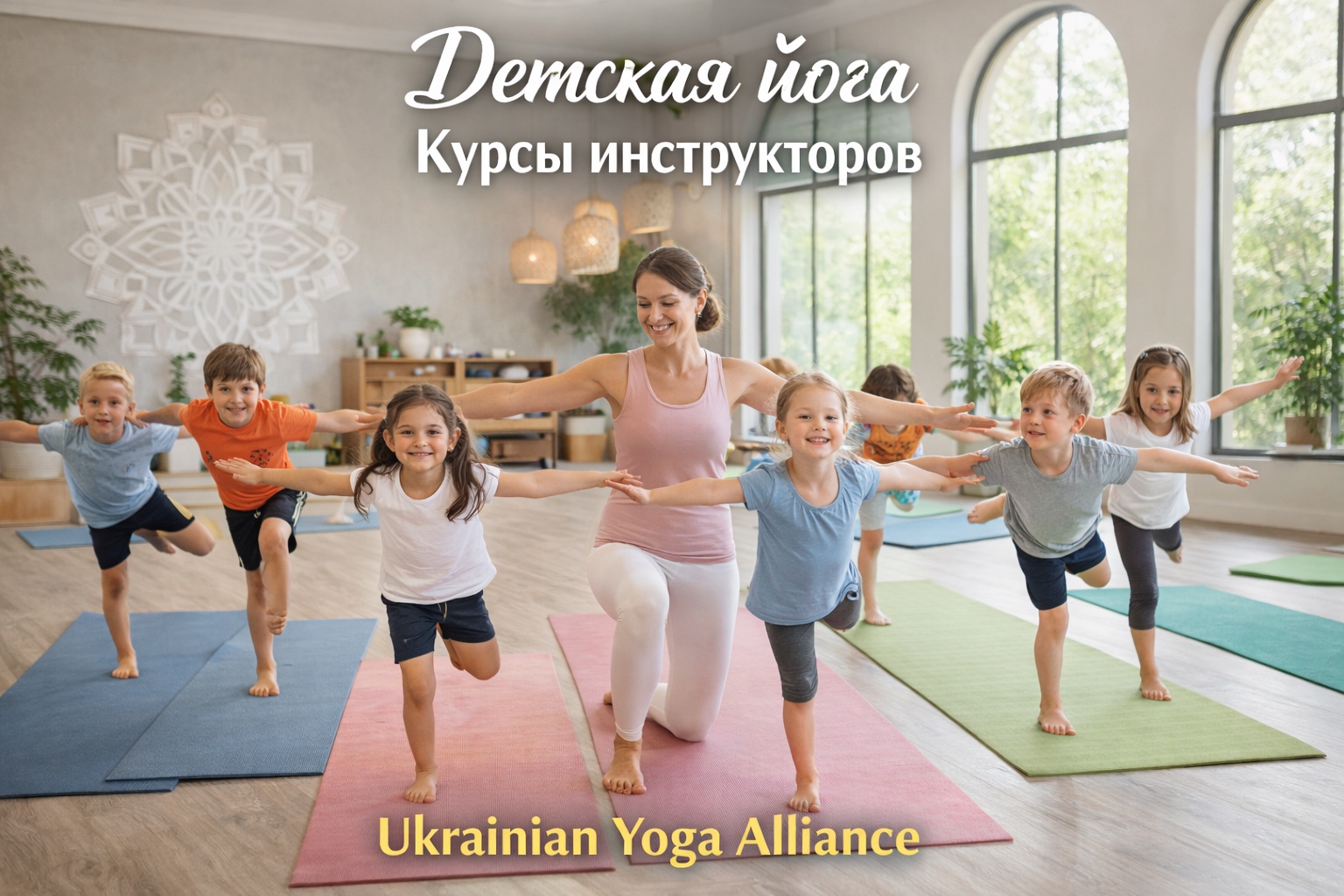
Children’s Yoga Instructor Training Courses. Children’s Yoga as a Professional Specialization for Yoga Teachers
You can read more about the Yoga Instructor Course on the course website:
kurspoyoge.com
Course registration:
📞 Phone: +380984777777
(Viber / Telegram / WhatsApp)
Yoga Alliance website:
yogaalliance.com.ua
The modern lifestyle of children has changed significantly over recent decades. High intellectual demands, prolonged sitting, intensive use of digital devices, reduced natural physical activity, and constant informational pressure have a considerable impact on a child’s physical and psycho-emotional condition. As a result, posture disorders, reduced concentration, chronic fatigue, anxiety, and difficulties with social adaptation are increasingly common among children.
For this reason, children’s yoga is now considered not merely an additional developmental activity but a systematic method for disease prevention, health improvement, and harmonious personality development. At the same time, global demand for professionally trained children’s yoga instructors continues to grow rapidly.
Children’s yoga instructor training courses in Ukraine provide an opportunity to obtain a modern international-level profession and complete professional education with an international certificate granting the right to teach children’s yoga in all countries worldwide.
Children’s yoga is an adapted system of classical Hatha Yoga designed according to age-related physiology, developmental psychology, and children’s perception characteristics. The practice combines yoga postures (asanas), breathing techniques, coordination exercises, balance training, relaxation methods, concentration practices, and educational game-based methodologies. The instructor’s primary role is not only to teach movements but also to create a safe developmental environment that supports a child’s natural physical and emotional growth.
Professional training for children’s yoga instructors includes an in-depth study of the anatomical and physiological characteristics of the growing body. A child’s body is in a stage of active formation: the spine develops, muscular systems strengthen, joints and ligaments mature, and the nervous system evolves intensively. Future teachers learn appropriate load management for different age groups and principles of safe class construction.
Special attention is given to the prevention of the most common health issues among children, including scoliosis, poor posture, muscular imbalance, physical inactivity, coordination difficulties, increased fatigue, and emotional instability. Properly structured children’s yoga classes allow gentle correction of these conditions without excessive physical stress.
Children’s yoga asanas are aimed at balanced strengthening of all muscle groups, improving flexibility, coordination, and balance. Developing a strong muscular support system promotes healthy spinal development, improves circulation, and positively affects the functioning of internal organs as well as respiratory and cardiovascular systems. Improved posture directly supports nervous system function and overall energy balance.
An essential component of instructor education is the study of child psychology. Teaching children requires a fundamentally different pedagogical approach compared to adult classes. Instructors learn to structure sessions through play, imagination, and creative interaction. A game-based format naturally maintains children’s attention while developing discipline without pressure or coercion.
Future teachers also study methods for developing attention, imagination, spatial awareness, and emotional stability in children. Asanas involving symmetrical body engagement stimulate cooperation between the brain’s left and right hemispheres, supporting both logical thinking and creative abilities.
A dedicated section of the training focuses on breathing techniques and emotional regulation. Mastering diaphragmatic breathing helps reduce anxiety, improve sleep quality, enhance concentration, and support recovery after academic stress. Instructors learn how to safely introduce breathing practices appropriate for children of different ages without causing strain or discomfort.
Methodology of class structure is another key element of professional preparation. The program covers lesson planning, logical sequencing of exercises, balancing activity and relaxation phases, safe transitions into and out of postures, and techniques for maintaining group engagement throughout the session. Special attention is devoted to safety standards and injury prevention.
Children’s yoga instructor courses also include fundamentals of pedagogy and communication with parents. Teachers learn how to explain the goals of yoga practice, provide recommendations regarding children’s physical development, interact professionally with families, and build trust in the educational process. A professional instructor becomes not only a teacher but also a mentor supporting a child’s development.
Children’s yoga practice promotes the development of self-regulation skills. Children gradually learn to manage attention, emotions, and behavior. This is especially important within modern educational environments characterized by high informational loads and stress factors.
Regular practice helps children recover more efficiently from mental fatigue, increases stress resilience, improves learning capacity, and enhances social interaction skills. Yoga builds self-confidence, internal stability, and the ability to remain calm in challenging situations.
Children’s yoga is particularly recommended for children experiencing high academic pressure, sedentary lifestyles, posture disorders, excess weight, emotional excitability, attention difficulties, or adaptation challenges. Yoga becomes an effective preventive tool against musculoskeletal disorders and functional nervous system disturbances.
Professional specialization in children’s yoga opens broad career opportunities. Certified instructors may work in yoga studios, fitness centers, schools, kindergartens, early development centers, rehabilitation institutions, or conduct private and family sessions. Children’s yoga remains one of the most stable and rapidly developing fields within modern yoga education worldwide.
The training program also addresses adaptation of yoga practice for different age categories, including preschool children, primary school students, and teenagers. Each age group requires specific teaching methodology, physical intensity levels, and psychological interaction strategies. Instructors learn to flexibly adjust programs according to group needs.
Yoga is viewed as a holistic system for developing body, mind, and consciousness. Working with children requires high responsibility, awareness, and professional competence. Children’s yoga instructor training forms a comprehensive understanding of teaching by integrating classical yoga knowledge with pedagogy, anatomy, and developmental psychology.
Beginning yoga practice at an early age establishes a lifelong foundation of health. Through regular practice, children develop body awareness, relaxation skills, concentration, and harmonious interaction with the surrounding world.
A professionally trained children’s yoga instructor becomes a guide toward a healthy lifestyle and balanced development of future generations. Children’s yoga instructor training courses represent not only professional qualification but also participation in shaping a physically healthy, emotionally stable, and socially adaptive society.
Teacher Training and Certification
The Ukrainian Yoga Alliance is the largest non-profit organization responsible for establishing and maintaining yoga teaching standards in Ukraine.
The main areas of activity of the Alliance include:
•uniting the professional yoga community;
•developing and approving qualification requirements;
•official certification of yoga instructors;
•maintaining the Unified Register of Certified Teachers.
The Ukrainian Yoga Alliance is the largest non-profit organization that establishes and maintains yoga teaching standards in Ukraine.
The main areas of activity of the Alliance include:
•uniting the professional yoga community,
•developing and approving qualification requirements,
•official certification of yoga instructors,
•maintaining the Unified Register of Certified Yoga Teachers.
Training Format and Examination
Within online yoga instructor training courses, students of the Yoga Alliance School undergo mandatory practical and theoretical assessment.
Passing Surya Namaskar is part of the examination process.
A video of the exam, conducted within online courses, is available via the link — click to watch.
You can watch a full video overview of the online course by the Head of the Yoga Alliance, Vladimir Bondarenko, on our YouTube channel by following the link.
Training Locations and Tuition Fees
Branches of the Yoga Alliance School have resumed operations in the following cities:
• Kyiv
• Kharkiv
• Dnipro
• Odesa
• Lviv
• Klaipėda (Lithuania)
• Bansko (Bulgaria)
• Athens (Greece)
• Prague (Czech Republic)
• Torrevieja (Spain)
• Vienna (Austria)
• Cascais (Portugal)
These branches offer continuously running offline yoga instructor training courses led by senior instructors of the Alliance.
Tuition fees:
•online course — 15,500 UAH
•offline course — 17,500 UAH
Since August 2022, instructors who successfully pass examinations with distinction receive the right to train future yoga instructors on behalf of the Yoga Alliance and conduct teacher training courses jointly with the Organization.
Such instructors receive the status of Senior Instructor of the Yoga Alliance and earn 50% of the course fee for each student.
For full details, contact us via Viber / Telegram / WhatsApp:
+380984777777
Training Results
After completing the one-month course and successfully passing the exams, you will:
•receive two international Yoga Alliance certificates registered with the Ministry of Justice of Ukraine;
•obtain the right to teach yoga in more than 100 countries worldwide;
•master a well-structured class format including kriyas, pranayama, and meditation;
•receive lifetime access to video lessons, an application for learning posture names, and 12 balanced printed lesson plans for the first year of teaching;
•receive the “Gold Standard” methodological guide — a detailed manual on asanas, chakras, mudras, bandhas, and key techniques of classical yoga.
Additional Materials
Contacts and Registration
You can read more about the Yoga Instructor Course on the course website:
Course registration:
📞 Phone: +380984777777
(Viber / Telegram / WhatsApp)
Yoga Alliance website:
Оставить комментарий