
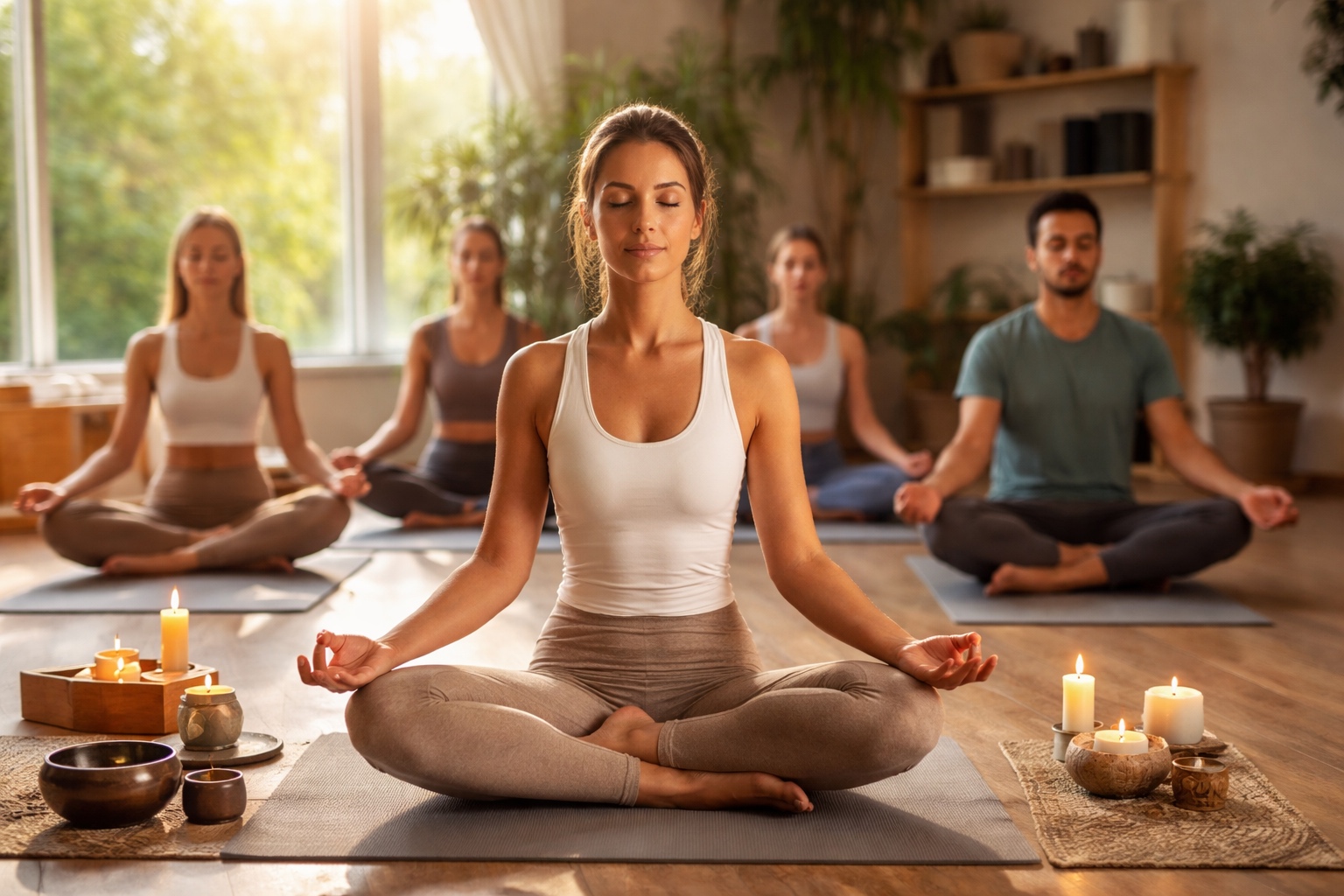
Meditation in Professional Yoga Instructor Training
You can read more about the Yoga Instructor Course on the course website:
kurspoyoge.com
Course registration:
📞 Phone: +380984777777
(Viber / Telegram / WhatsApp)
Yoga Alliance website:
yogaalliance.com.ua
Within the system of professional yoga teacher education, meditation occupies not a supplementary but a central position. It is not an elective discipline and not an additional option to asana and pranayama practice, but a key element in forming a mature, stable, and competent instructor.
A future yoga teacher must not only understand the philosophy of meditation and know its stages theoretically, but also possess consistent personal practical experience. Without firsthand experience of concentration, inner silence, and stable attention, it is impossible to correctly transmit the subtle aspects of practice to students. An instructor who has not undergone inner work may teach physical form, but cannot convey the essence.
Professional instructor training предполагает systematic work with the body, breath, and consciousness, where meditation becomes the natural culmination of all previous practice.
Meditation as a Professional Competency of the Teacher
For a future yoga instructor, meditation is not merely a state of calmness. It is a developed skill of managing attention and inner processes.
Meditation develops:
• the ability to regulate one’s psycho-emotional state;
• resilience to stress and external stimuli;
• clarity of thinking in demanding situations;
• deep concentration while leading a group;
• inner discipline and composure;
• the ability to hold the energetic and psychological space of a class.
An instructor with a stable meditation practice is able to maintain inner balance even under high workload. Such a teacher does not become emotionally involved in students’ fluctuations, does not lose stability in unexpected circumstances, and does not react impulsively.
Thus, meditation becomes the foundation of professional maturity.
Physiological and Psychological Changes in Practice
Regular meditation practice has a comprehensive effect on the body and nervous system.
From a scientific perspective, the following changes are observed:
• reduced hyperactivity of the amygdala, responsible for emotional reactions;
• decreased cortisol levels (the stress hormone);
• improved regulation of the autonomic nervous system;
• increased tone of the vagus nerve connecting heart and brain;
• enhanced neuroplasticity;
• improved cognitive function and long-term concentration ability.
For a yoga teacher, this means:
• emotional stability;
• reduced anxiety;
• higher quality of attention;
• steadiness in interpersonal interaction;
• the capacity for deep focus while leading practice.
Meditation forms not only psychological but also physiological resilience, which is especially important for instructors working with people.
Meditation and Relaxation — A Fundamental Difference
It is important to understand that meditation is not equal to relaxation.
Relaxation is a state of rest and temporary tension release. It may be beneficial, but it does not lead to qualitative transformation of attention.
Meditation is a guided process of concentration, mental discipline, and gradual expansion of awareness.
True meditative practice is impossible without preparation:
• a stable, symmetrical, and physiologically correct posture;
• a purified and strengthened body;
• balanced and conscious breathing;
• the ability to hold attention on a chosen object;
• reduction of chaotic mental activity.
If the body is unstable, the breath irregular, and the mind restless, deep meditation cannot occur. In such cases, it is merely relaxation or imagination.
Professional instructor training includes step-by-step preparation for meditative states through asana, pranayama, and the development of concentration.
Three Stages of Meditative Practice in Instructor Training
The classical system describes three consecutive states: dharana, dhyana, and samadhi. They are not mechanical exercises, but natural stages in the development of attention.
1. Dharana — Concentration
Dharana is the ability to hold attention on a single object without distraction.
According to traditional definition, concentration is considered stable if attention is maintained for 12 seconds without interruption.
For a future instructor, this is the stage of cultivating mental discipline. One learns to:
• notice distractions;
• gently return attention to the object;
• maintain one-pointed focus;
• preserve inner stability.
Dharana cannot be forced by willpower. One can only create the conditions for its emergence through systematic practice.
2. Dhyana — Meditation
Dhyana is an uninterrupted flow of attention toward the object.
If dharana is holding a point, dhyana is a smooth, continuous flow without breaks. Traditionally, the duration of dhyana is defined as 12 dharanas (144 seconds).
At this stage, effort disappears. Attention becomes steady, calm, and continuous. A deep connection forms between the observer and the object of observation.
For a teacher, this means developing the capacity for prolonged focus without internal tension.
3. Samadhi — Complete Absorption
Samadhi is a state in which the opposition between subject and object disappears.
Consciousness no longer separates “I” from the object of observation. A sense of wholeness arises.
Samadhi is not a goal that can be achieved through effort. It is the natural result of sustained and deep dhyana.
In professional education, the emphasis is not on pursuing spectacular states, but on gradually cultivating stable attention and discipline.
The Impossibility of Forced Meditation
Dharana, dhyana, and samadhi cannot be “performed” at will.
One cannot simply sit down and decide, “Now I will meditate.” If the mind is chaotic, thoughts contradictory, and the body tense, deep states will not arise.
Attempting to forcibly suppress thoughts may lead to inner conflict and psychological strain.
Therefore, instructor training places special emphasis on creating the necessary conditions:
• consistent asana practice;
• disciplined breathing;
• development of observation;
• gradual reduction of mental agitation.
Only after stable dharana naturally arises can dhyana follow, and eventually deeper states may become possible.
Practical Purpose of the Meditation Module in Training
The meditation module in yoga instructor training aims to cultivate:
• stable attention;
• emotional maturity;
• inner discipline;
• the ability to manage mental states;
• clarity of thinking;
• deep awareness.
Even at early stages, trainees begin to experience:
• inner stability;
• reduced reactivity;
• clarity of perception;
• a sense of balance;
• improved concentration.
Over time, a mature teaching personality is formed — calm, attentive, composed, capable of guiding students not only through form but through state.
Conclusion
Meditation in professional yoga instructor education is not a mystical practice or emotional experience, but a disciplined training of the mind.
It is a path of gradual cultivation of attention, stability, and inner maturity.
Without mastering meditation, a full understanding of pranayama, advanced techniques, and yoga philosophy is impossible.
A professional instructor is not the one who demonstrates complex asanas, but the one who can maintain clarity, stability, and awareness in any situation.
Such a foundation is formed through systematic meditative practice within yoga teacher training.
Teacher Training and Certification
The Ukrainian Yoga Alliance is the largest non-profit organization responsible for establishing and maintaining yoga teaching standards in Ukraine.
The main areas of activity of the Alliance include:
•uniting the professional yoga community;
•developing and approving qualification requirements;
•official certification of yoga instructors;
•maintaining the Unified Register of Certified Teachers.
The Ukrainian Yoga Alliance is the largest non-profit organization that establishes and maintains yoga teaching standards in Ukraine.
The main areas of activity of the Alliance include:
•uniting the professional yoga community,
•developing and approving qualification requirements,
•official certification of yoga instructors,
•maintaining the Unified Register of Certified Yoga Teachers.
Training Format and Examination
Within online yoga instructor training courses, students of the Yoga Alliance School undergo mandatory practical and theoretical assessment.
Passing Surya Namaskar is part of the examination process.
A video of the exam, conducted within online courses, is available via the link — click to watch.
You can watch a full video overview of the online course by the Head of the Yoga Alliance, Vladimir Bondarenko, on our YouTube channel by following the link.
Training Locations and Tuition Fees
Branches of the Yoga Alliance School have resumed operations in the following cities:
• Kyiv
• Kharkiv
• Dnipro
• Odesa
• Lviv
• Klaipėda (Lithuania)
• Bansko (Bulgaria)
• Athens (Greece)
• Prague (Czech Republic)
• Torrevieja (Spain)
• Vienna (Austria)
• Cascais (Portugal)
These branches offer continuously running offline yoga instructor training courses led by senior instructors of the Alliance.
Tuition fees:
•online course — 15,500 UAH
•offline course — 17,500 UAH
Since August 2022, instructors who successfully pass examinations with distinction receive the right to train future yoga instructors on behalf of the Yoga Alliance and conduct teacher training courses jointly with the Organization.
Such instructors receive the status of Senior Instructor of the Yoga Alliance and earn 50% of the course fee for each student.
For full details, contact us via Viber / Telegram / WhatsApp:
+380984777777
Training Results
After completing the one-month course and successfully passing the exams, you will:
•receive two international Yoga Alliance certificates registered with the Ministry of Justice of Ukraine;
•obtain the right to teach yoga in more than 100 countries worldwide;
•master a well-structured class format including kriyas, pranayama, and meditation;
•receive lifetime access to video lessons, an application for learning posture names, and 12 balanced printed lesson plans for the first year of teaching;
•receive the “Gold Standard” methodological guide — a detailed manual on asanas, chakras, mudras, bandhas, and key techniques of classical yoga.
Additional Materials
Contacts and Registration
You can read more about the Yoga Instructor Course on the course website:
Course registration:
📞 Phone: +380984777777
(Viber / Telegram / WhatsApp)
Yoga Alliance website:
Оставить комментарий